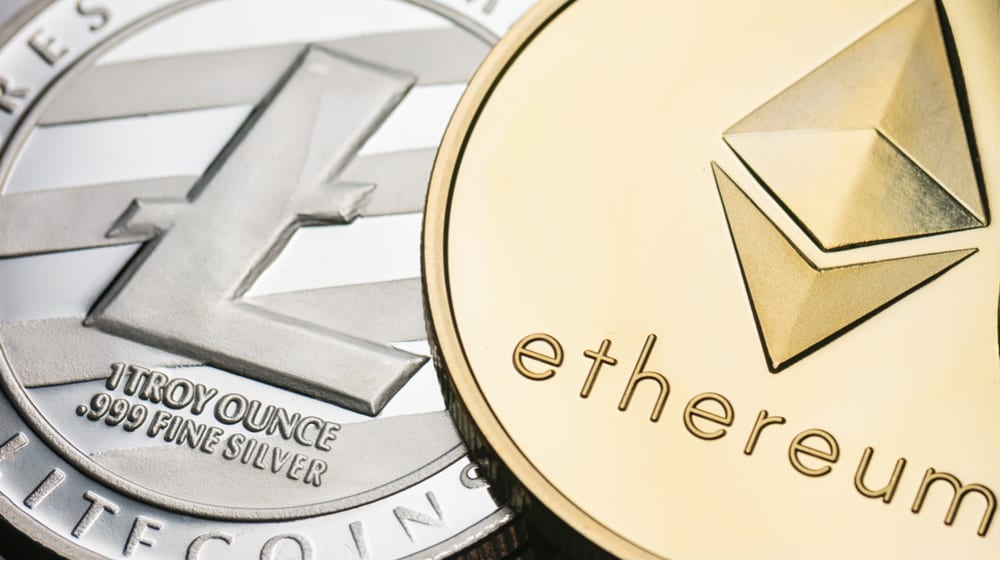
Cryptocurrencies have evolved beyond simple digital cash, with different projects serving unique purposes in the blockchain space. Among the most well-known digital assets, Litecoin (LTC) and Ethereum (ETH) stand out as two major players with distinct use cases. While Litecoin was designed as a faster and cheaper alternative to Bitcoin, Ethereum introduced the concept of smart contracts and decentralized applications (dApps).
This article provides a detailed yet concise comparison of Litecoin and Ethereum, exploring their purpose, technology, mining, supply, and market relevance to help traders and crypto enthusiasts make informed decisions.
1. Understanding Litecoin and Ethereum
1.1 What is Litecoin (LTC)?
Litecoin was created by Charlie Lee in 2011 as a “silver to Bitcoin’s gold.” It is a peer-to-peer payment system designed for fast and cost-effective transactions. Built on Bitcoin’s core code, Litecoin introduced modifications to increase speed and reduce fees, making it a practical choice for daily transactions.
Key Features of Litecoin:
- Uses the Scrypt hashing algorithm, which is more memory-intensive than Bitcoin’s SHA-256.
- Has a fixed supply of 84 million coins.
- Faster block generation time of 2.5 minutes, compared to Bitcoin’s 10 minutes.
- Lower transaction fees compared to Bitcoin and Ethereum.
1.2 What is Ethereum (ETH)?
Ethereum was launched in 2015 by Vitalik Buterin as a programmable blockchain that allows developers to create and deploy smart contracts and decentralized applications (dApps). Unlike Litecoin, Ethereum is not just a digital currency but an entire ecosystem for decentralized finance (DeFi), non-fungible tokens (NFTs), and other blockchain-based innovations.
Key Features of Ethereum:
- Uses Ethereum Virtual Machine (EVM) to support smart contracts and dApps.
- Transitioned from Proof of Work (PoW) to Proof of Stake (PoS) with Ethereum 2.0.
- No fixed supply, but incorporates a burn mechanism (EIP-1559) to reduce inflation.
- High adoption in DeFi, gaming, and tokenized assets.
2. Key Differences Between Litecoin and Ethereum
2.1 Purpose and Use Cases
- Litecoin is a fast and efficient payment system, optimized for transactions and value transfer.
- Ethereum is a multi-purpose blockchain that enables smart contracts, DeFi, and dApps.
2.2 Consensus Mechanism and Mining
- Litecoin relies on Proof of Work (PoW) using the Scrypt algorithm, allowing for faster block generation.
- Ethereum initially used PoW but transitioned to Proof of Stake (PoS) to improve energy efficiency and scalability.
2.3 Transaction Speed and Fees
- Litecoin’s block time is 2.5 minutes, making transactions faster than Bitcoin but slower than Ethereum.
- Ethereum’s block time is 15 seconds, but network congestion can cause higher gas fees.
- Litecoin has lower fees, making it better suited for day-to-day transactions.
2.4 Supply and Token Economics
- Litecoin has a capped supply of 84 million LTC, providing scarcity similar to Bitcoin.
- Ethereum has no hard supply cap, but the introduction of EIP-1559 burns a portion of fees to create deflationary pressure.
3. Market Performance and Adoption
3.1 Market Capitalization and Price Trends
- Ethereum is the second-largest cryptocurrency by market cap, with a valuation of over $300 billion.
- Litecoin has a much smaller market cap, typically ranking in the top 20 cryptocurrencies.
- Ethereum’s price is significantly higher than Litecoin price, reflecting its broader ecosystem adoption.
3.2 Adoption in Real-World Use Cases
- Litecoin is accepted by many merchants as a payment option due to its low fees and fast processing.
- Ethereum powers the majority of DeFi applications, NFTs, and metaverse projects, making it more versatile.
4. Pros and Cons of Litecoin vs Ethereum
4.1 Advantages of Litecoin
✔ Faster and cheaper transactions compared to Bitcoin and Ethereum.
✔ More decentralized mining due to the Scrypt algorithm.
✔ Fixed supply, making it a deflationary asset like Bitcoin.
4.2 Advantages of Ethereum
✔ Smart contract capabilities enable a wide range of decentralized applications.
✔ Strong developer support and continuous innovation (e.g., Layer 2 solutions like Optimism and Arbitrum).
✔ High institutional adoption, making it a long-term investment choice.
4.3 Limitations of Both
✖ Litecoin lacks smart contract functionality, limiting its use cases beyond payments.
✖ Ethereum struggles with high gas fees and scalability, requiring Layer 2 solutions.
5. Which One Should You Choose?
- For payments and transactions? → Litecoin is the better choice due to low fees and fast processing.
- For smart contracts and dApps? → Ethereum is unmatched in DeFi, NFTs, and blockchain development.
- As an investment? → Ethereum has greater long-term growth potential, but Litecoin offers stability and lower entry costs.
Conclusion
Litecoin and Ethereum serve distinct purposes in the cryptocurrency space. While Litecoin remains a fast and efficient payment system, Ethereum continues to dominate as a platform for decentralized innovation. Both have strong market relevance, and the choice between them depends on your goals—whether for payments, investments, or blockchain applications.
By understanding their key differences in purpose, technology, mining, supply, and market impact, investors and traders can make more informed decisions on which cryptocurrency aligns with their strategy.